Article: The Sublime Art of Collecting Vintage Watches
The Sublime Art of Collecting Vintage Watches
A Dialogue with Time
At Contre-Temps, a collection is not an accumulation. It is a personal, interior and considered practice — built slowly, over time. It places the collector on a path paved with emotional experiences, one step after another: discovery first, then desire, and finally understanding.
Vintage watches lend themselves particularly well to this approach. Through beautiful, precise and complex objects — ones that can be touched, and even acquired — they allow us to read the parallel evolution of design, technique and use across a century. They are living witnesses: historical, sometimes singular, to the intersection of technical ingenuity and the cultural and artistic history of the twentieth century.
To collect vintage watches is to refuse immediacy. It is to favour patience, observation and knowledge. One must search, wait, and sometimes walk away. Each watch becomes for the collector both an artefact and a reward — bearing within it the marks of a manufacture's exacting standards and aesthetic ambitions on one side, and the personal fulfilment of a quest on the other.
Evolution Without Betrayal
The finest vintage watches are those that evolved without ever betraying their original intention. Proportions refined, never exaggerated. Dials composed, never cluttered. Cases drawn with precision, never for effect.
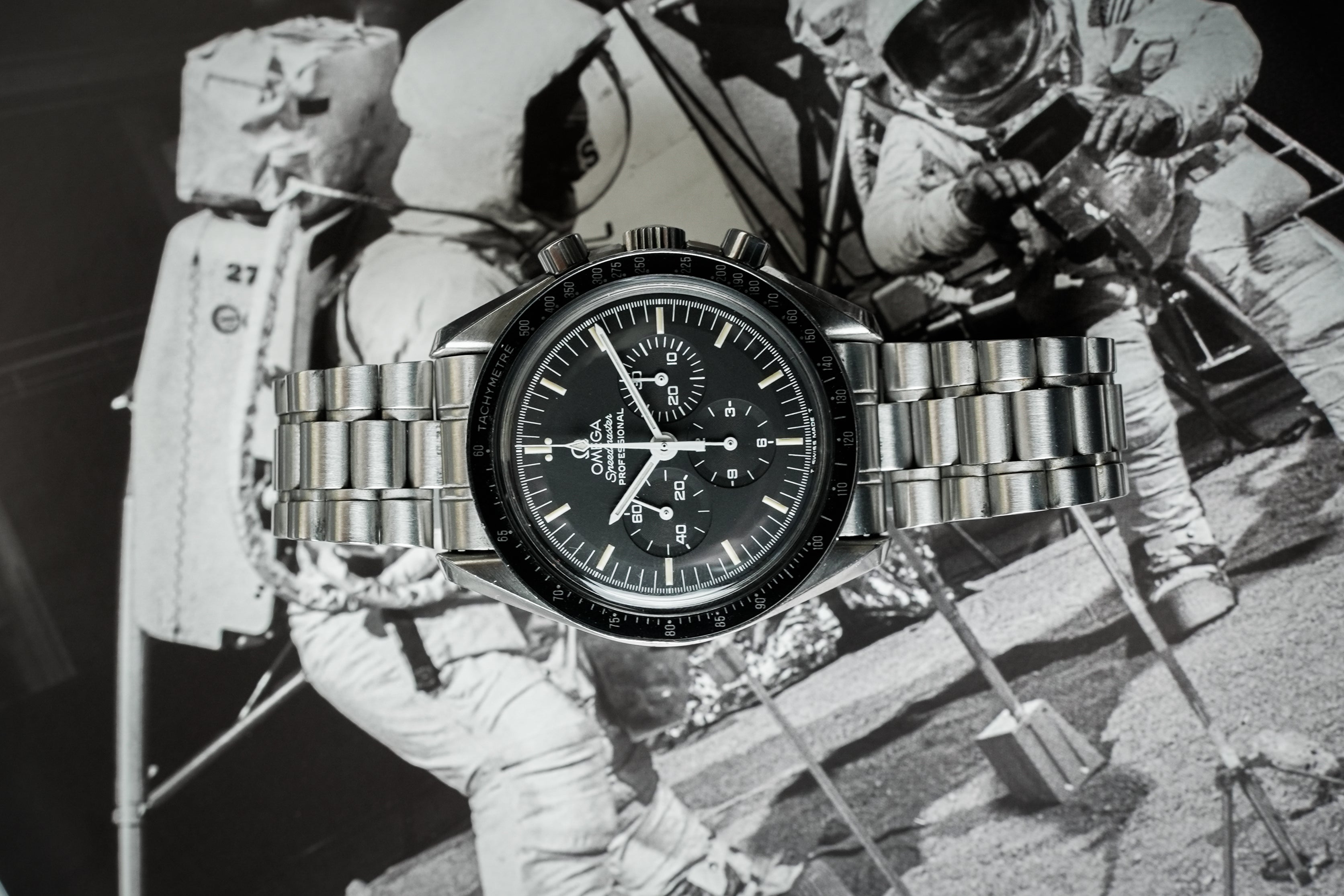
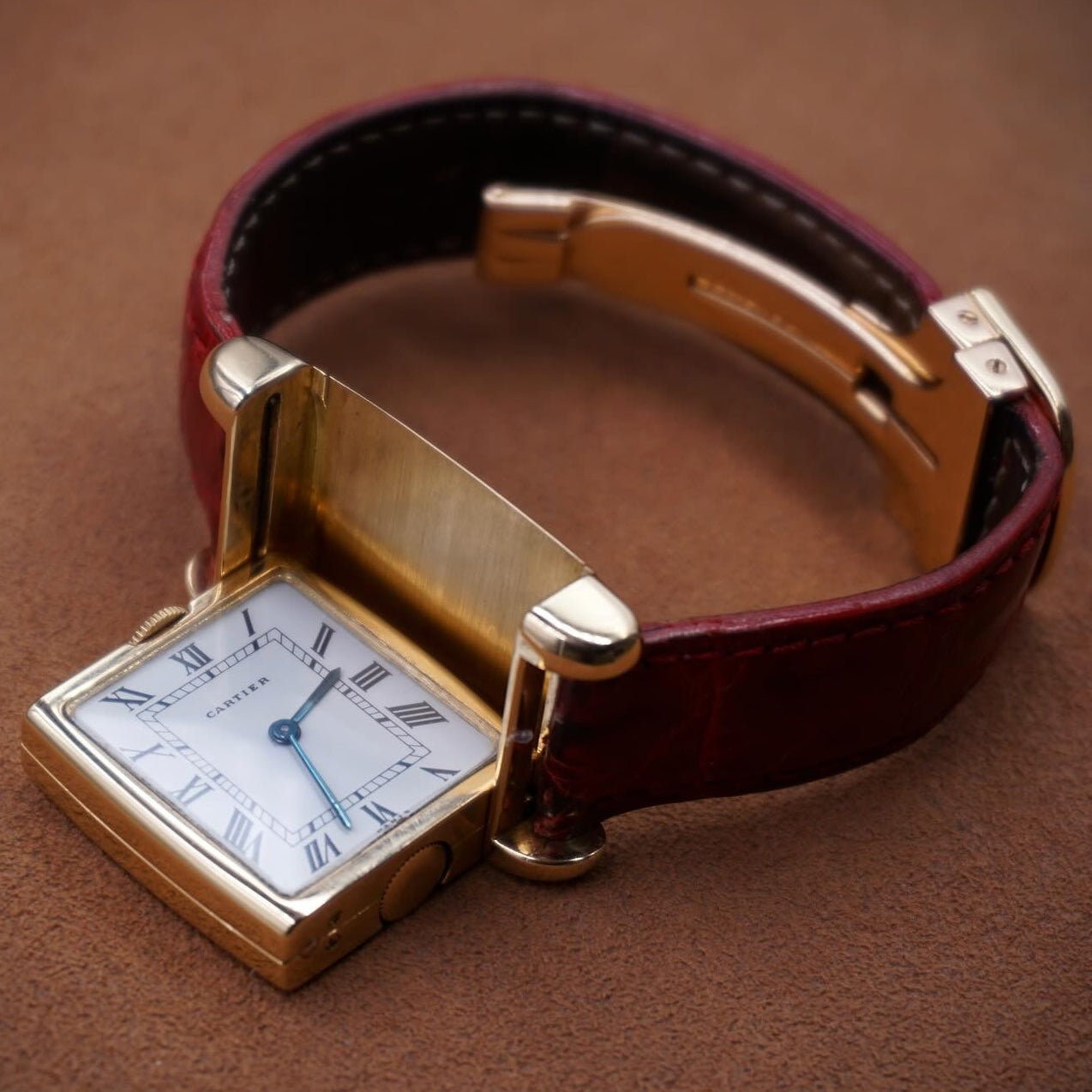
Swiss watchmaking at mid-century excels in this form of restraint. A Patek Philippe Calatrava, a Rolex sports reference, a professional Omega or a Cartier Tank — none of these sought novelty. They sought balance. Their enduring relevance lies precisely in that refusal of excess. Decades later, these designs remain legible, coherent and deeply contemporary.
At Contre-Temps, we place particular importance on original condition. Patina is not a flaw — it is a trace. A slightly altered lacquer, softened case edges, evolved tritium: these confer a depth that no restoration can recreate. Authenticity always prevails over perfection.
Yet over the course of a long life measured in decades, and when condition demands it, the intervention of a skilled watchmaker may have proved necessary. Such work must be limited to targeted operations — stabilisation, replacement of strictly functional components, regulation — favouring wherever possible the preservation of aesthetic elements, original components and the reversibility of interventions, in order to safeguard the integrity and authenticity of the watch.
What matters is not age alone, nor the hypothetical certainty of a piece that is "entirely original and never polished", but overall coherence: original intention, quality of execution, state of preservation and the reference's place in the manufacture's history and the lineage of horological expertise.
Mechanical Intelligence as Heritage
Before industrial optimisation and digital computation, mechanical watchmaking was an exercise in applied intelligence. Movements were conceived, adjusted and finished by hand — often in small series, sometimes experimentally, always with intent.
Complications were not marketing arguments — they were responses to real needs. The chronograph measured professional or sporting time. Calendar mechanisms engaged with astronomical cycles. Ultra-thin or minimalist calibres explored the physical limits of material.
Jaeger-LeCoultre occupies a central place in this culture, supplying bespoke — sometimes extreme — movements to the greatest houses while pursuing its own independent research. Universal Genève elevated the chronograph to an aesthetic statement. Breguet extended a centuries-old tradition of horological thought into the modern wristwatch, under real-world constraints and in demanding conditions. These pieces are not obsolete technologies — they are a genuine literature of mechanical history, rendered at the smallest scale.
To Wear, Not to Preserve
A vintage watch finds its fullest expression on the wrist. It is in use that it recovers its function and its meaning. The weight, the diameter, the curvature, the way light settles on a dial or case — these remind us why certain aesthetics, imagined decades ago, remain entirely relevant today.
The fact that a watch can still be worn, regulated and used in its original functions and complications attests to a technical soundness that transcends time. This continuity of use is one of the most reliable markers of a piece's quality and interest to the collector. Combined with an aesthetic that has remained coherent, it confers upon the watch a form of timelessness that goes beyond its status as a historical object.
There is also an undeniable intimacy between a collector and their watch. A quality common to all these pieces is the genuine pleasure of being able to wear them — continuing to cultivate and enjoy an experience born at the moment of discovery, deepened at the moment of acquisition, and renewed each time one chooses to put the watch on.
Collecting watches demands attention and understanding, and offers in return a faithful and enduring presence — a reminder that time is lived as much as it is measured.
Value as Consequence
Where speculation has colonised contemporary watch discourse, vintage collecting remains grounded in tangible criteria. Appreciation over time results from historical relevance, mechanical quality, aesthetic coherence and rarity — a rarity which, unlike current production, is here definitive.
What survives of the twentieth-century watchmaking tradition owes its existence to time, care and chance. These pieces will never be made again. Their very existence is the result of a unique convergence of craft, industrial context and creative intent that belongs, now, to history. It is precisely this irreversibility that underpins their value — not as a promise of return, but as a documented reality.
Outright speculation, by contrast, is a precarious game. Betting on the next fashionable reference, following forums and auction results like a market index — this is trading dressed up as collecting. The finest pieces can end up losing their intrinsic depth to a passing popularity that is, by definition, temporary.
The enlightened collector follows a different path. They develop, patiently, a sensitivity to what gives a piece its depth: its design history, the reasons for its creation, the context in which it was born, and the place it occupies today in the great creative history of the wristwatch. A watch created to meet a precise need, worn by exacting professionals, produced in a small series at a pivotal moment — these are the markers of a piece that endures with dignity.
This intelligence of choice is harder to acquire than the capital needed to buy. It is built through study, direct experience of pieces and historical curiosity. But it is infinitely more satisfying — and often more rewarding — than a blind wager on rarity or reputation.
At Contre-Temps Paris, we believe that value must flow from passion — never the reverse.
The references that follow illustrate precisely this conviction — as a proposal rather than a pronouncement.
Twelve Reference Vintage Watches for Men
An ideal men's collection is never encyclopaedic. It is organised around landmarks — watches that crystallise key moments in twentieth-century design and functionality. These pieces were not born iconic; they became so through coherence, use and precision of intent.
Such a collection balances elegance and functionality: a dress watch, an aviation or exploration instrument, a professional chronograph, a design departure, mechanically defining references. It traces the evolution of the wristwatch without ever sacrificing elegance.

Patek Philippe Calatrava Ref. 96
The founding expression of the modern dress watch.
Rolex Submariner Ref. 5512 / 5513
Functional purity made universal.
Jaeger-LeCoultre Reverso (early references)
Art Déco rigour born of a sporting constraint.
Omega Speedmaster CK2998 / 105.003
Pre-Moon chronographs defined by their balance.
Audemars Piguet Royal Oak Ref. 5402
A disruption that became a tradition.
Breguet Type XX
An aviation chronograph rooted in intellectual tradition.
Universal Genève Compax / Tri-Compax
Mastered complexity without sacrificing elegance.
Cartier Tank Louis Cartier
Geometry carried to its purest expression.
Piaget Ultra-Plate (9P & 12P)
Technical audacity expressed with restraint.
Longines 13ZN Flyback
A mechanical masterpiece defined by its flyback function.
Breitling Navitimer Ref. 806
A navigation instrument of uncompromising identity.
Rolex GMT-Master Ref. 1675
The defining travel watch of the modern era.
Twelve Iconic Vintage Watches for Women
Women's watchmaking has long been underestimated — too often reduced to its jewellery dimension. Yet the twentieth century produced remarkable pieces in which design, craft and mechanics engage with genuine rigour.
An ideal women's collection explores different landmarks: bold geometries, the fusion of jewellery and watch, the affirmation of house identities. These creations are not adaptations — they are works in their own right.

Cartier Tank Louis Cartier (women's)
Architectural balance, consistently expressed.
Chanel Première (early models)
A Parisian reading of contemporary watch design.
Boucheron Reflet
Jewellery elegance applied to the wristwatch.
Hermès Kelly Watch
A symbolic object born of the language of leather goods.
Piaget Ultra-Plate (women's)
Extreme refinement at the boundary of jewel and mechanism.
Patek Philippe Calatrava (women's)
Classical authority and perfect discretion.
Rolex Oyster Perpetual two-tone
A balance of robustness and refinement.
Jaeger-LeCoultre Duoplan & Calibre 101
Among the smallest movements ever conceived.
Van Cleef & Arpels Cadenas
Design as the primary language; timekeeping as a secondary one.
Audemars Piguet rectangular / oval models
Restraint and sophistication.
Cartier Baignoire (original)
An organic form and a thoroughly Parisian elegance.
Bulgari Serpenti Tubogas
Sculptural fusion of jewellery and watchmaking.
Collecting as Discipline
A collection is never built by chance. It rests on study, patience and the acceptance of error. References, movements and condition all matter — but coherence prevails.
The finest collections tell a vision, far more than they document an accumulation.
The quality of a collection also depends on the quality of its sources. The vintage watch market is vast, uneven and sometimes opaque. Between generalist platforms, major auction houses and specialist dealers, the difference rarely lies in the asking price — it lies in the expertise that precedes the listing.
At Contre-Temps Paris, every piece offered has been selected, authenticated and serviced before being made available for sale. No shortcuts, no compromises. A standard built over nearly thirty years in the heart of the 7th arrondissement of Paris — and today accessible online from anywhere in the world.
For the serious collector, trust in one's dealer is not a comfort — it is a condition.
Understanding Time

Vintage watches endure because they were made with seriousness. Functional objects, aesthetic creations and intellectual achievements at once, they embody a rare form of equilibrium.
To collect them today is not to look backwards. It is to take one's place in a continuity where time is understood as much as it is measured.